

Human Reasoning and Forming Logical Conclusions
We live in a world of opinions. We reason, develop attitudes and take logical positions, and we argue to defend our positions. The search for truth is an ongoing and complicated process, especially when you consider that people do not always think or speak the truth: they can be wrong, intentionally lie, or even rationalize in deceptive ways.
The ancient Greek’s found it useful, in the search for truth, to engage in reasoned arguments with another philosopher to get to the truth of something over which they disagreed. They called this process dialectic.
4 Types of Reasoning

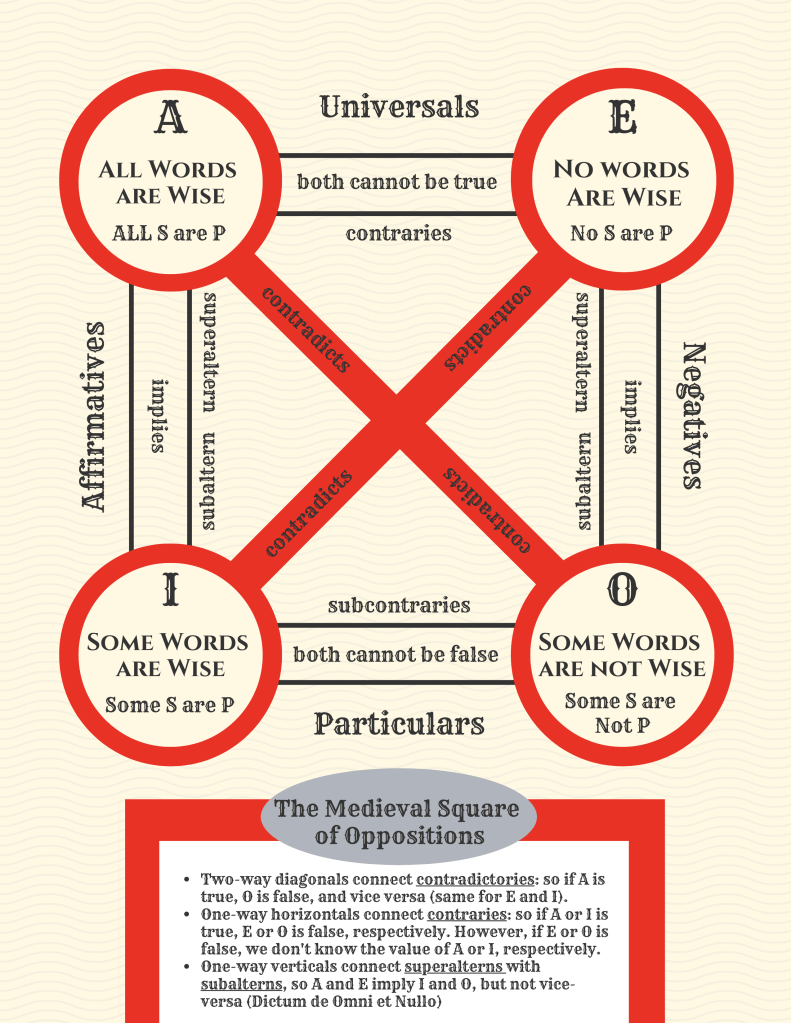
The Medieval Square of Oppositions
Adapted from Aristotle’s On Interpretation. The table shows the hidden relationship between various types of proposition: contraries, contradictories, subcontraries, subalterns and superalterns.
It is important to note that for Aristotle, and in traditional logic, all statements, universal (A and E) and particular (I and O), imply the existence of their subjects.
- For example, in the example that follows, the statement “All words are wise” implies that words exist.
 Professor Gomez